Purple Prairie Clover
Purple Prairie Clover (Dalea purpurea)
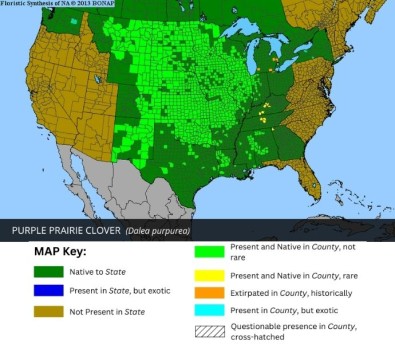
Range: Dalea purpurea is native to a large portion of North America, ranging from eastern British Columbia to western Alabama and as far west as Arizona. This plant is an important component of Great Plains grassland communities and is commonly found in tallgrass, shortgrass, and mixed-grass prairies.
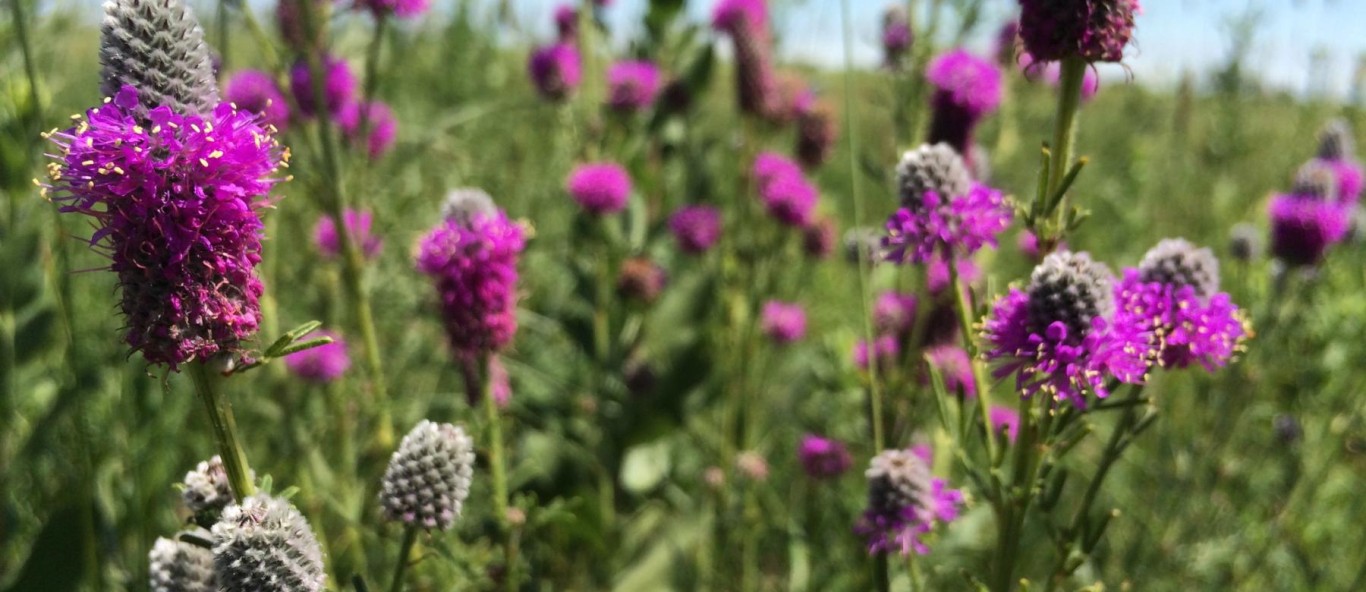
Description & Impact: Purple prairie clover is a perennial herb growing 8 to 35 inches tall. The mature plant has a large taproot 5.5 to 6.5 feet deep. The stem is woody with several branches. The leaves are a few centimeters long and are divided into 3 to 7 narrow fern-like leaflets. The flowers atop each stem branch are spikes up to 2+3⁄4 inches long containing many purple flowers. The fruit is a legume pod containing 1 or 2 seeds. The nectar and pollen attract many bees, wasps, flies, butterflies, and skippers. Several plasterer bees (genus Colletes) are specialist pollinators of this species, and other insects eat the seeds and leaves. It is a larval host to the southern dogface (Zerene cesonia.)
Plant Medical History: Indigenous peoples of North America have used Dalea purpurea for centuries to address various health concerns. It has been employed as a remedy for digestive issues, respiratory ailments, and as a poultice for wound healing. This plant contains several bioactive compounds that contribute to its medicinal properties, including flavonoids, tannins, and alkaloids.
Cultivation & Garden Use: This plant can grow in USDA zones 3-8 and requires full sun to grow. This plant is adapted to a habitat with periodic wildfires. In some areas, it depends on fire to clear encroaching woody vegetation, as it cannot tolerate shade. As a nitrogen-fixing legume, it enriches prairie soils by converting atmospheric nitrogen into forms that other plants can use, making it a keystone species in healthy grassland ecosystems. This species is used for revegetation efforts on reclaimed land. It is good for preventing erosion due to its large root system. Though it is often found in mid-to late-successional stages of ecological succession, it may also be a pioneer species, taking hold in bare and disturbed habitat, such as roadsides.