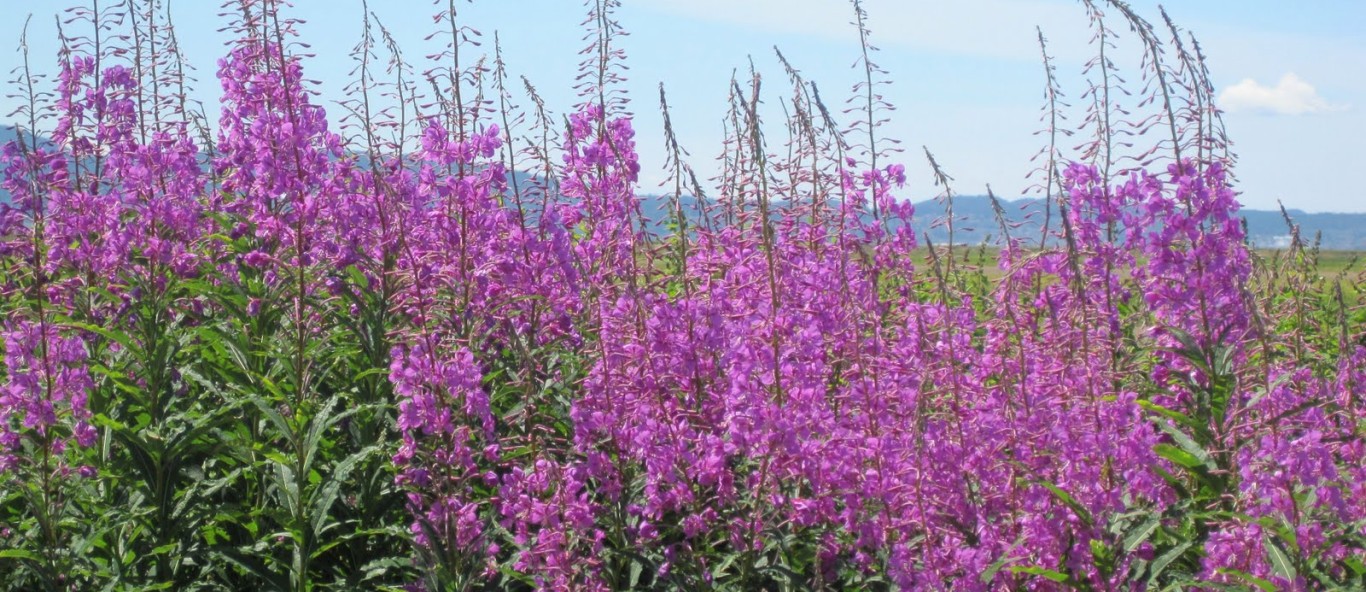
Fireweed
Fireweed (Chamaenerion ansustifolium)
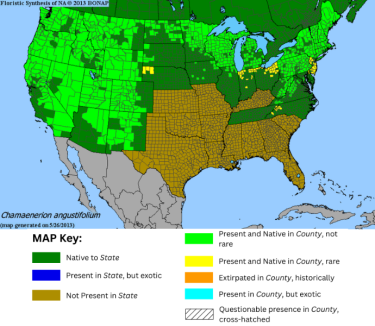
Range: Chamaenerion angustifolium is a native perennial of the temperate Northern Hemisphere. It is widely distributed across boreal forests, open woodlands, and disturbed areas such as burned ground and roadsides.
Description & Impact: Fireweed has reddish stems that are simple, erect, smooth, growing to 1.5-6.5 feet high. It has scattered alternate leaves that are spirally arranged, entire, narrowly lanceolate, and pinnately veined. The flower cluster blooms progressively from bottom to top, producing a tapered shape. The flowers are 2 to 3 centimeters in diameter, with four magenta to pink petals and four narrower pink sepals. It is a pioneer species that quickly colonizes open areas with little competition. Some species in the butterfly and moths family frequently use the willowherb as their primary larval host-plant, including the elephant hawk moth (Deilephila elpenor), the bedstraw hawk moth (Hyles gallii), and the white-lined sphinx moth (Hyles lineata).
Plant Medical History: Indigenous peoples used fireweed to treat coughs, colds, and sore throats. Some applied it as a salve to draw out infection from wounds or placed raw stems on pus-filled boils or cuts to draw out pus and prevent rapid scabbing. Europeans found it effective for aiding in prostate health, urinary discomfort, and as a general tonic.
Cultivation & Garden Use: Fireweed grows in USDA zones 2-7, and prefers full sun and well-drained, nutrient-rich soils, though it can tolerate poorer soils when competition is minimal. It bears many minute brown seeds, about 300 to 400 per capsule and 80,000 per plant. The seeds have silky hairs to aid wind dispersal and are very easily spread by the wind, often becoming a weed and a dominant species on disturbed ground. Once established, the plants also spread extensively by underground roots. Its natural tendency to colonize disturbed areas makes it a great addition for ecological restoration projects. It can be an especially useful when planted after prescribed fires and logging events because of its fire resistance and ability to recycle the nutrients left in the soil after a fire.