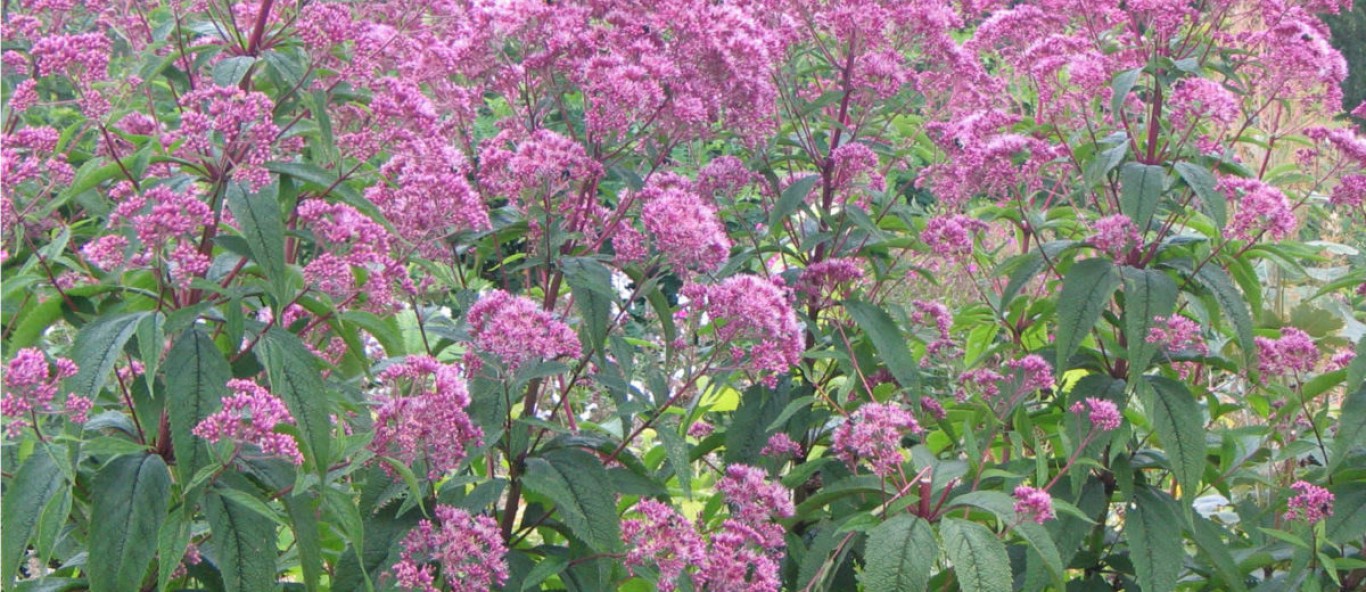
Joe-Pye Weed
Joe-Pye Weed (Eutrochium purpureum)
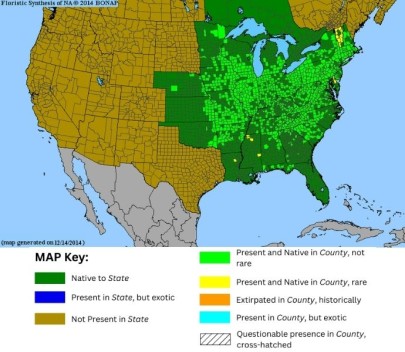
Range: Eutrochium purpureum is an herbaceous perennial plant in the family Asteraceae. It is native to eastern and central North America, from Ontario east to New Hampshire and south as far as Florida, Louisiana, and Oklahoma. It can be found in a variety of tall grass settings and mesic woodland habitats.
Description & Impact: Joe-pye weed is a clump-forming herb that grows 4.5–7.5 feet tall and spreads about 4 feet wide. Their stems are upright, thick, round, and purple, with whorls of leaves at each node. The leaves grow to 12 inches long and display a wrinkled texture. As the plant begins to bloom, the stems often bend downward under the weight of the flowers. The pink-purple tubular blooms form large domed or flat‑topped clusters, opening in mid-to-late summer and attract much activity from insects that feed on the nectar produced by the flowers. It is larval host to the eupatorium borer moth (Carmenta bassiformis), the red groundling moth (Perigea xanthioides), the ruby tiger moth (Phragmatobia fuliginosa), and the three-lined flower moth (Schinia trifascia.)
Plant Medical History: Joe-Pye weed is perhaps best known as a natural diuretic, supporting normal kidney and urinary tract function. Herbalists have also used it to support the body’s response to occasional fluid retention and to encourage gentle detoxification through the urinary system. It was valued for helping with occasional fevers when consumed as a warm tea to promote perspiration. In addition, the herb has been used to support joint and muscle comfort, digestive regularity and healthy lymphatic circulation.
Cultivation & Garden Use: The plant grows well in USDA zones 4-9 and are most often found in full sun to part shade in mesic to wet soils. The plant is tolerant of clay soil and wet soil, and mature plants even have some tolerance for short periods of drought. Joe-Pye weed can self-seed, but the division of roots is an easy way to propagate mature Joe-Pye weed plants. It is best done in early spring as soon all danger of frost has passed, but propagation in the fall can also be successful. The disease to look out for is powdery mildew; avoid overhead watering to help prevent this issue. It is ideal for pollinator gardens, meadows, borders, and rain gardens, adding height, texture, and ecological benefit by providing critical late‑season nectar when few other plants bloom.