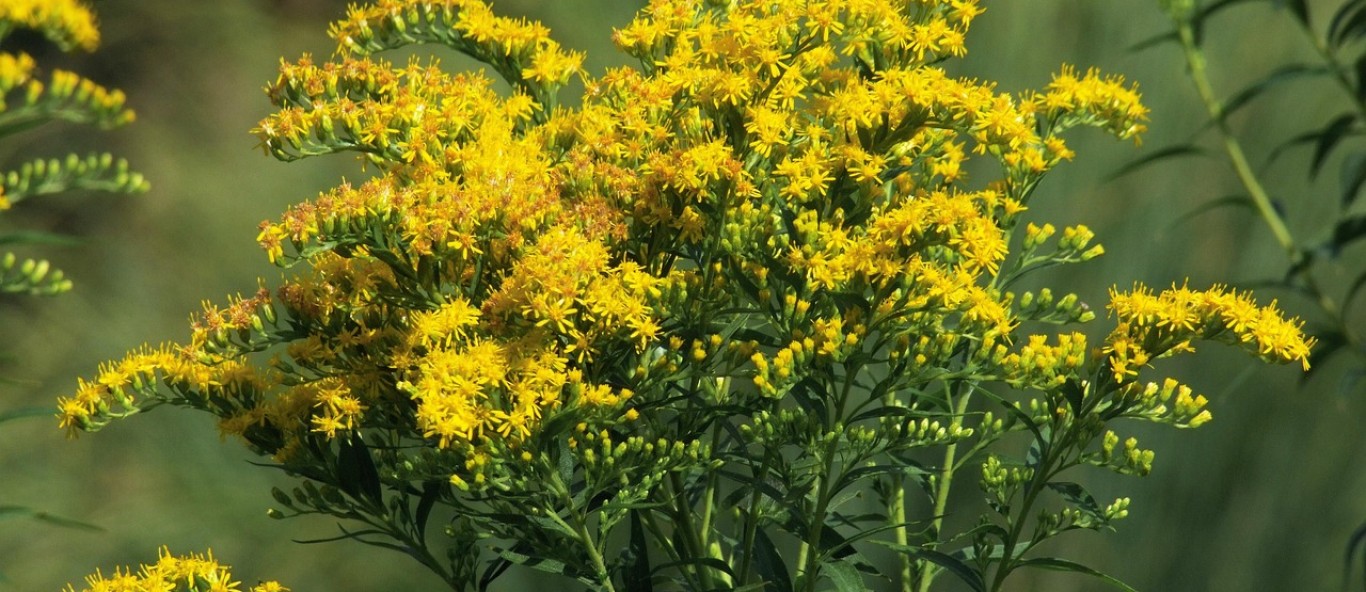
Canadian Goldenrod
Canadian Goldenrod (Solidago canadensis)
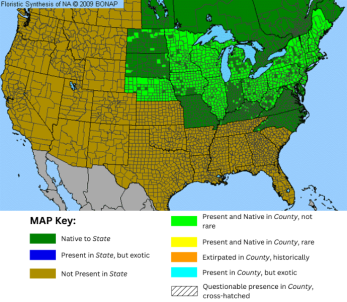
Range: Solidago canadensis is native to northeastern and north-central North America, with a broad distribution across Canada and the contiguous United States. It can commonly be found in open, disturbed areas such as meadows, prairies, savannas, forest edges, abandoned farmlands, pastures, fields, thickets, waste areas, and roadsides.
Description & Impact: Canadian goldenrod is an herbaceous perennial plant with stems that grow 2–4 feet and sometimes to 6 ft. tall. The lanceolate to broadly linear shaped leaves are alternately arranged on the stems. The leaves are 4–6 inches long and 1 inch wide. The stems have lines of white hairs, while the undersides of the leaves are pubescent. The leaves are often prominently toothed. The flowers have yellow rays and are arranged into small heads on branched pyramidal shaped inflorescences, and flowering occurs from August to October. It has a rhizomatous growth habit, which can produce large colonies of clones. Canadian goldenrod is visited by a wide variety of insects for its late-season pollen and nectar, including bees, wasps, flies, beetles, butterflies, and moths.
Plant Medical History: Canadian goldenrod has played an important role in various cultures. The plant was used in traditional medicine for its anti-inflammatory, diuretic, and antiseptic properties. It was used to treat wounds, sore throats, fevers, and kidney problems. It contains strong antioxidant effects, and was commonly used to support urinary tract health, reduce inflammation, and alleviate allergy symptoms.
Cultivation & Garden Use: This plant is winter hard in USDA zones 3-9 and is very adaptable to its environment. It is found in both very dry locations and also waterlogged ones. It not only seeds itself prolifically but also spreads rapidly via running rhizomes. It can be extremely aggressive and may need to be thinned from time-to-time to prevent is from taking over an entire area. It may be browsed occasionally by deer, and lends itself to other wildlife, especially pollinators. Many wasps and flies form galls inside the stem of goldenrod when laying their eggs. There are stem, flower, and bud galls, which are crucial to overwintering the larva of these insect species.