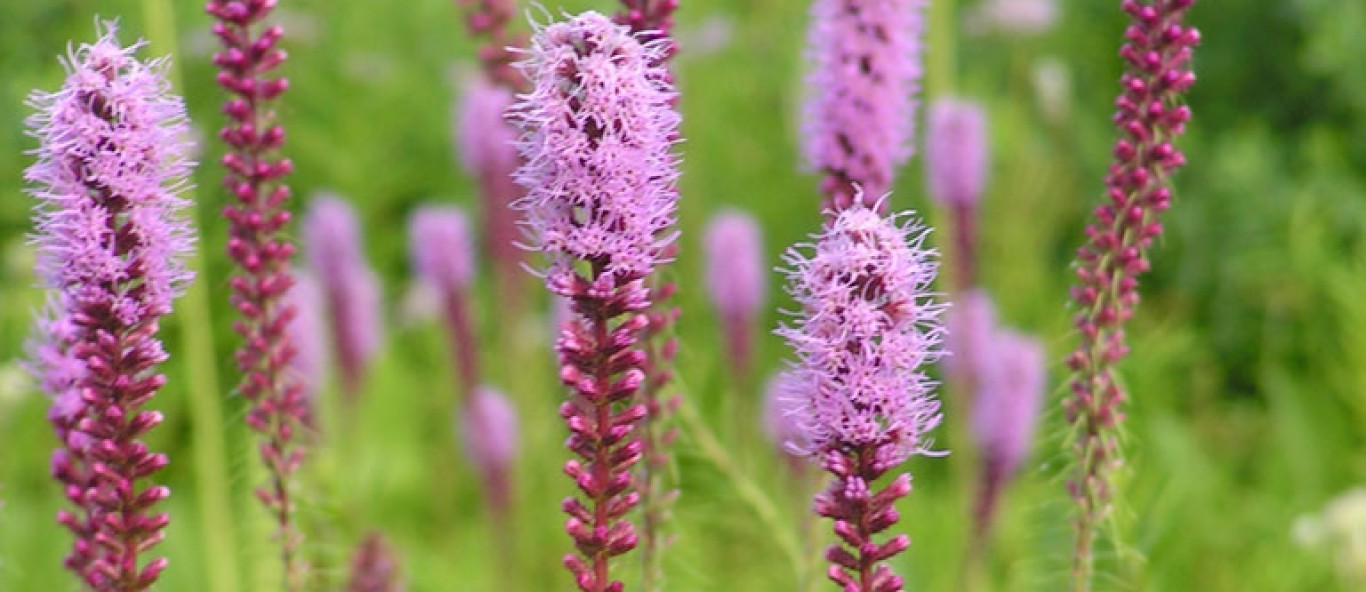
Prairie Blazing Star
Prairie Blazing Star (Liatris pycnostachya)
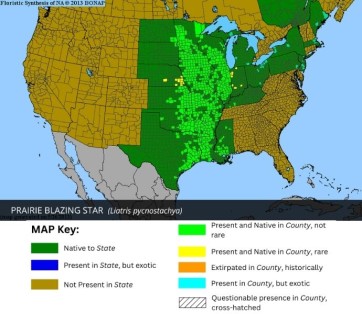
Range: Liatris pycnostachya is native to central and southeastern North America, with its core range spanning the Central United States and parts of the southeast. It is a tall prairie wildflower that thrives in the tallgrass prairie ecosystem and is well adapted to fire-prone, open habitats.
Description & Impact: These plants are typically 2–5 feet tall, with a single erect, unbranched stem from a corm (bulb-like underground storage organ.) The stem is stout, leafy, and often covered with scattered hairs. The leaves are displayed alternately, are linear (grass-like), dark green, with a prominent midvein. The lower leaves are 8–16 inches long and up to ½ inch wide, tapering upward. The flowers are dense clusters of 5–10 tubular disc flowers in purple to violet, subtended by purplish bracts with pointed tips. The spike is densely packed, creating a continuous column of color. Flowers open from the top downward, lasting 3–4 weeks through July and August. This plant's flowers attract bees, butterflies, hummingbirds, and birds, and the seeds are eaten by songbirds.
Plant Medical History: Native American tribes recognized the plant’s healing potential long before European contact. The roots were the primary medicinal part, rich in natural compounds used to prepare decoctions and poultices for a variety of ailments. The plant was used to support respiratory health, digestive regularity, wound care and cold/flu relief.
Cultivation & Garden Use: Prairie blazing star grows in USDA zones 3-9 and prefers 6+ hours of full sun each day. It thrives in well-drained prairie or garden soil, but tolerates clay, loam, or sandy soils as well. Its water needs are low to moderate, and once established, it requires little irrigation. It is deeply adapted to prairie ecosystems, tolerating fire, drought, and poor soils. The underground corm allows survival through harsh conditions. Its flowers support monarch butterfly migration and other pollinators, making a great addition to perennial borders, prairie gardens, naturalized areas, cottage gardens, and pollinator gardens.